A lifestack is a list of things that help manage my life — ranging from consumption items to tools, from digital projects to foundational principles of how to operate in private and public spheres. Jack Baty has an excellent model here. A public-facing lifestack must omit a lot, but I like sharing my server setup and outdoors self.
Computing
All of my computing machines have hostnames based on literary and mythological owls. My daily driver laptop is named after a Greek figure transformed into a nocturnally bound owl; my desktop after a Welsh strigiformean goddess; my home server nodes after Ascalaphus (buried under a rock by Demeter, freed by Heracles, changed back into an owl by Demeter again), Blodeuwedd (turned into a gwdihŵ by Gwydion), and Glimfeather (from Narnia).
Daily driver laptop: Nyctimene
- Lenovo ThinkPad X1 Carbon (20U9), Intel i7-10610U, 16 GB RAM
- CachyOS with Niri (Wayland compositor); Ghostty terminal; fish shell
- Doom Emacs as primary writing and coding environment; Neovim for SSH/remote contexts
- Denote for note-taking; Magit for git; chezmoi for dotfiles
Daily driver desktop: Arianrhod
- Lenovo ThinkStation P300, 32 GB RAM
- CachyOS with Niri (Wayland compositor); Ghostty terminal; fish shell
- Doom Emacs as primary writing and coding environment; Neovim for SSH/remote contexts
- Denote for note-taking; Magit for git; chezmoi for dotfiles
- An adjacent lava lamp and ceiling projector of the Milky Way to perform vibemaxxing
Secondary laptop: Cailleach
- Lenovo ThinkPad T440p, 16 GB RAM, Intel i5
- Runs StumpWM with minimal configuration; Emacs-focused
- Dated with a good keyboard; a glorified word processor that theoretically presents a portal for zero distraction
- May drop even StumpWM and create a TTY/Emacs-only console
Appliance laptop: Kauz
- Apple MacBook Air 2020, 8 GB RAM, Intel i5; a former work machine that I bought for $100
- It used to be Lechuza, the witching owl of the Hispanic Southwest, but I renamed it Kauz (German for a small or odd owl) once I had stripped it down to a video-and-browser appliance. Dev tooling, dotfiles, Syncthing, the VPN, and most apps are gone, so the name Lechuza is free for a future device
- Runs Sequoia, and it is used mainly for YouTube at dinner and Safari and nothing else
E-Reader
- Kobo Elipsa with Kobo Stylus
- Runs KOReader for a dramatically better reading experience than the stock interface
- Native ePub support; Calibre server integration via built-in browser
Apple iPhone 13
- iSH, Working Copy, and Scriptable for small projects and remote server access
- Möbius Sync for Syncthing integration across the tailnet
- Beorg for Org file editing and calendar integration
- Journelly for on-the-go notetaking
- Health tracking: Renpho, Welch Allyn, Garmin Connect
Home server: Parliament
Inevitably, the home server cluster is called Parliament.
Ascalaphus
- Apple Mac Mini, 16 GB RAM; headless Proxmox host
- Headless Proxmox runs a variety of LXCs (Jellyfin, Calibre, Forgejo, Uptime Kuma, Homepage, NocoDB, the Syncthing hub that snapshots my Org files, and Pi-hole/Unbound among them) and a couple of VMs (Proxmox Backup Server, plus Home Assistant, which is currently stopped)
- Mirrored ZFS setup: zfslager (after the German above-ground storage; two mirrored 4TB disks) and zfskeller (after a German cellar; two mirrored 12TB disks); every drive on the box is USB-attached, which is a known fragility and a standing item on my to-do list
- Caddy reverse proxy with internal DNS at
*.parliament.home.arpa - Tailscale subnet router; SMB share from ZFS pools
Blodeuwedd
- HP 600 G2 Micro, Intel i7, 32 GB RAM, 512 GB SSD
- Second node in the same Proxmox cluster
- Serves as the main Docker machine, a Dockge-managed VM that runs most of the server services below
- Hosts a Debian VM for miscellaneous server work
Glimfeather
- Raspberry Pi 3B with DietPi
- Third node in the Proxmox cluster, there to achieve quorum and little else (despite the fall in reputation for Raspberries, I love that little guy)
Backup
I back up the ZFS pools offsite with restic to S3 Glacier Deep Archive, and restic encrypts everything before it leaves the house. Locally, Proxmox Backup Server copies the pools to USB drives (unencrypted, for now) in datastores named after trees associated with longevity: redwood, bristlecone, and sitka. The point of all this is not to lose the data in a zealous moment of bad scripting, and not to let the blackhats do their thing.
General computing services
- Syncthing: Indispensable for keeping Org files, articles, and documents aligned across all machines and phones
- Amazon S3 Glacier Deep Archive: Cold storage via restic
- Bitwarden Premium: Passwords, attachments, secure sharing; using rbw as CLI client rather than the Electron desktop app
- 2FAS Auth: Two-factor authentication
- Mullvad VPN: Best commercial VPN in my view
- Tailscale: WireGuard-based mesh VPN tying Parliament together
- Firefox with Multi-Account Containers: Primary browser and has been for decades; completely replaced Chrome as a portal to teaching job after the Sonatype-2026-003775 AUR supply chain incident convinced me to audit my setup
- DuckDuckGo and Startpage: So-so replacements for the other graph-climbing distributed computing system
- Dropbox: Still in use for file sharing with people not invested in the self-hosting universe
- YouTube Music: Replaced Spotify Premium. Mostly for Mexican Doomer, double B-sides, and Alice Coltrane deep cuts. But mainly to play “Black Sail” by Chastity Belt on repeat.
The streaming compensation problem remains unsolved. SoundCloud, once a plausible alternative model, quietly updated its terms in 2024 to allow AI training on independent artists’ uploads while protecting major label content — the opposite of artist-first. I remain a Lanier sympathizer on data dignity: his framing of AI as collaboration-of-humans rather than autonomous entity, and his insistence that contributors to that collaboration deserve acknowledgment and compensation, still strikes me as correct. The infrastructure to actually implement it remains politically inert, as it has been since Who Owns the Future? in 2013.
General software
Emacs
My digital life revolves around Org Mode. I use Doom Emacs and have mostly stopped tinkering with it, which is an achievement.
- Denote: For notes, seedlings, and evergreens; replaced Org-Roam
- Citar: Bibliography management and reference insertion
- Org Journal: Dailies and fleeting notes
- Org Modern: Makes things prettier and more professional
- Org Chef: Recipe capture
- Magit: Git in Emacs; I do almost all my pushing and pulling here
- ox-hugo: Org-to-Hugo export for this site
Configuration and security
- Chezmoi: Dotfiles management; works well once you wrap your head around its arcana
- GPG
- Tor: I used to be in a band called Stealing Jokes. We were always on tor.
- Forgejo: Self-hosted git on Parliament; this site’s repo is mirrored there, and so are my dotfiles, my Doom Emacs config, and the homelab scripts. It also holds the history of my Org files (a hub on the server commits automatic snapshots to one branch every ten minutes, and I commit deliberate changes to another from one machine at a time), and etckeeper history for my machines is pushed to it
Server services
Most of these run as Docker stacks on Blodeuwedd (Audiobookshelf, Calibre Web, Dockge, FreshRSS, Immich, Kavita, Kiwix, Linkwarden, Navidrome, Paperless-ngx, Pinchflat, and Scanopy). Jellyfin, Uptime Kuma, Homepage, NocoDB, and Forgejo are LXCs on Ascalaphus, and Home Assistant is a VM there, currently stopped.
- Homepage: The dashboard for everything below; it carries a variety of widgets, plus some hand-built ones for logging things through its API
- Audiobookshelf: Self-hosted audiobook and podcast server
- Calibre Web: E-book collection management
- Dockge: Docker container management with a sensible GUI
- FreshRSS: RSS and Atom feed aggregator; primary way I consume the web
- Home Assistant: Security cameras and smart home without Sting’s involvement (the VM is currently stopped, but I’ll be watching you)
- Immich: An extraordinary photo and video management system; ought to be purchased
- Jellyfin: Personal media server with VAAPI hardware acceleration
- Kiwix: Offline access to Wikipedia, Project Gutenberg, Khan Academy
- Linkwarden: A decent replacement for things like Pocket (which I only used briefly); a self-hosted bookmarks manager, though it needs better external apps
- Navidrome: Personal music streaming; great for burned CDs of yesteryore
- Paperless-ngx: Excellent digital document management; the iOS app makes life incredibly easy, and it has swallowed most of my medical paperwork in lieu of a proper system
- Pinchflat: YouTube media manager; downloads playlists so nothing is lost. It serves as one of several memory holes (Linkwarden being another) in addition to preserving worthy musical and artistic content from the site
- Uptime Kuma: Service monitoring
- Kavita: A nice accompaniment to Calibre Web; an interface for comics, manga, and ebooks
- Scanopy: Network discovery and mapping
- NocoDB: A reading and watching database, with more than 1,500 records of major works of literature (fiction, nonfiction, and poetry) that I have read since my teenage years and about 1,000 TV shows and films of note from my childhood on. It also tracks hikes, peaks ascended, and some health measures, and it is a nice way to get spreadsheet and database behavior without a lot of code wrangling
Website
- This site is Compass Rose, built with Hugo and PaperMod, deployed via Netlify, authored in Org Mode via ox-hugo and occasionally in plain Markdown. GitHub hosts the source, with a mirror on my own Forgejo.
Fitness
- Garmin Instinct 2 Solar: Daily health, sleep, and fitness tracking; advanced use on backpacking trips
- Renpho Elis 1 Smart Body Scale: Weight and body composition tracking
- Welch Allyn blood pressure monitor
Hiking & backpacking
I favor a semi-light approach to backpacking: influenced by ultralight principles but not beholden to them. Leave no trace and stay off the wildflowers.
Bags
- Deuter ACT Lite 65+10: For international travel, extended trips, and heavier loads (a discontinued model; now the Aircontact Lite)
- REI Co-op Trail 40 Pack (1.3 kg, with a rain cover and trekking-pole holders): UL-leaning expeditions and day hikes
Shelter and sleep
- Six Moon Designs Lunar Solo (26 oz): Main UL tent with trekking pole setup
- REI Co-op Magma Trail Quilt 30 (850-fill goose down): I enjoy a quilt over a sleeping bag in most conditions
- Thermodown zero-degree mummy bag (1.3 kg) for winter and late-season; it is bulky and not remotely UL, but forgiving when damp
Water and food
- MSR PocketRocket Deluxe (80 g) with a regulator that simmers well, and a 138 g OUTXE titanium pot for freezer-bag cooking
- Katadyn BeFree: Main water filtration
- Chlorine dioxide tablets as backup (Portable Aqua or Katadyn Micropur M1)
- Nalgene bottles; 1L gas station water bottle
- Dehydrated foods; calorie-dense bars; nuts; dehydrated blueberries and cherries
- Rope system for food storage; bear canister when conditions require it
Clothing and footwear
- Trail runners in most conditions: Salomon Sense Ride 4s, a discontinued model that is now due for replacement, with Danner Trail 2650s for when I want something sturdier
- Waterproof socks and boots for marshy trails and stream crossings (e.g. Uintas)
- Merino wool base layer and socks
- Black Yak hiking pants; rain jacket
- Anti-microbial underwear
Ditty bag
- Curated first-aid kit: ibuprofen, anti-diarrheals, prescriptions, super-glue, KT tape, Israeli bandage
- Spoon with spork feature
- Backcountry bidet, trowel, hygiene gear
- Emergency items: mirror, foil, cordage, emergency blanket, matches, whistle, fishing line and hooks
Knives
- L.T. Wright GNS Saber: Workhorse bushcraft knife
- Victorinox Swiss Army knife for simpler tasks
Safety and navigation
- Bear repellent (not taken every trip; responsive to conditions) and bear bells
- Garmin inReach Mini on an annual subscription that includes search-and-rescue coverage
- Suunto A-30 compass, with National Geographic topo maps for the High Uintas, the Northern and Southern Wasatch, and Great Basin National Park; OsmAnd on the phone for offline maps
- Black Diamond Storm 500-R headlamp, with several knock-off headlamps stashed in packs for redundancy
- Black Diamond Trail Back trekking poles, which double as the Lunar Solo’s tent poles. The locking mechanism can let a lower segment slip, and I carry the replacement part to prove it
Home
- Yamaha acoustic guitar from my dad and sister
- Casio PX-870 Keyboard, 88 velocity-sensitive keys: My wife is a very good piano player; I am working on it
- Audio Technica LP120 (from 2006) with speakers and mixer. Some favorites from a very modest vinyl collection:
- The Beatles Love Songs (scratched and warm and a little lumpy around “You’ve Got to Hide Your Love Away”)
- The Copland Album (Prairie Night from Billy the Kid remains one of my favorite stretches of American melody)
- Switched-On Bach (a replacement of an original I beat up in the 1980s and once tried to fix with school paste in the grooves; I was eight)
- A Love Supreme
- Eden (Talk Talk)
- Con Todo el Mundo (Khruangbin)
- Ravel: Bolero – Ma mère l’Oye – Pavane pour une infante défunte – La Valse
- 아침이슬 (Morning Dew, a double vinyl by Yang Hee-Eun released in 1987)
- Seagull Music (from my mom’s classroom)
- Hakko soldering station
- Various Arduinos
- Roku Onn Smart TV: dumb, likely listening, and the spy-iest thing I probably own
- Entertainment: Netflix, YouTube, Amazon Prime Video, Jellyfin for personal collection
- AKORN Kamado Charcoal Grill, Sapphire (housewarming gift from my dad)
- Vermiculture and composting system
Social media
To free yourself, to be more authentic, to be less addicted, to be less manipulated, to be less paranoid … for all these marvelous reasons, delete your accounts.
— Jaron Lanier, Ten Arguments for Deleting Your Social Media Accounts Right Now
- Facebook: Technically exists, deactivated for a long time
- GitHub: Most projects now private; also self-host Forgejo on Parliament
- Instagram: Currently private, focused mainly on hiking. Meta is a noxious spy and algorithm manipulator, but I haven’t pulled the plug yet.
- Twitter/X: I don’t post or like anything. Occasionally tune in for a handful of interesting accounts.
- Bluesky/Mastodon: Have accounts on both; never post on either.
Edification
Knowledge management
Digitally: Denote, Journelly, Org Journal, Citar, Calibre, and Zotero for notes, references, and sources.
Analog: A Moleskine for daily fleeting notes, which many get integrated into my monthly Org Journal file. When I was 12 or so, I began learning an alphabetic shorthand called Speedwriting (and I think I may have dabbled in Stenoscript, too, at some point). I use a bastardized version of it in the Moleskine and on other analog sources, though I’m very rusty and only use a subset of the possibilities.1
Longer fleeting notes live in Org Journal and Journelly. Some become seedlings, which occasionally grow into posts here.
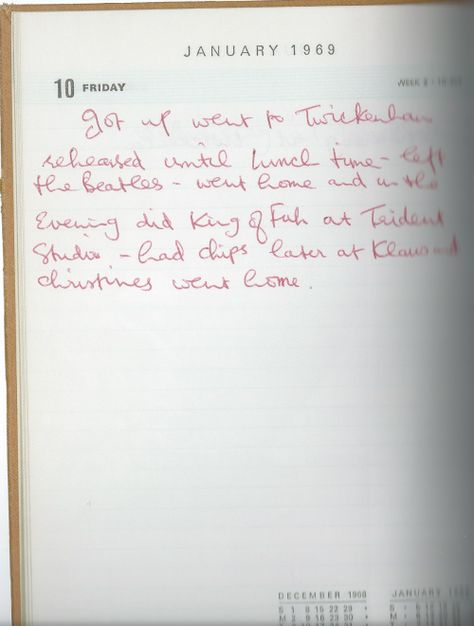
Daily short-form entries are called “Facta diei,” and I have been consistently taking these since early 2022. It’s a short diary format that lists out my daily actions, and it was actually inspired by George Harrison’s diary style in the late 1960s, with this humorous and curious entry (“left the Beatles”) the stand-out inspiration:
YouTube channels
I subscribe promiscuously under a pseudonymic account. Some I’m comfortable sharing publicly:
- 2hearts1seoul: My wife and I love their videos of Seoul and Nova Scotia
- The Bear Essentials: Bushcraft without the nonsense
- 3Blue1Brown
- Verisatium
- Blogothèque
- Collative Learning: Fascinating film analyses
- DW Deutsch: Ja
- Nahre Sol
- David Bennett Music Theory
- Nerd of the Rings: Savo ’lass a lalaith
- Rirang on Air: Enthusiastic eating and no-frills camping
- find404: Creates videos that are ultimately deeply humane
Podcasts
Not a huge fan of podcast culture, but these have earned sustained attention. I listen to Deutschlandfunk quite a bit, though the experience feels more like listening to the radio from another era:
- Daniel and Isabel Save Classical Music
- Close Readings with Kamran Javadizadeh: Gillian White on Elizabeth Bishop is great; Johanna Winant on Dickinson’s “My Life had stood — a Loaded gun” changed my thinking about that poem
- Deutschlandfunk: Hintergrund
- The History of English Podcast: Nū scylun hergan hefaenrīcaes Uard…
- Revolutions: From the Levellers to the dust of 1848
- Eine Stunde History
- Claire on Air
Everyday carry
- Small cross-body Samsonite shoulder bag
- Green Maxpedition Medium Fatty Pocket Organizer:
- Emergency blanket; battery pack; USB cables
- Pens, mechanical pencil and lead
- Band-Aids and basic first aid; flossers; toothpaste
- Cash in several currencies; backup keys; basic documents
- Backup prescription pills
- Emergency cloth tablets
- Moleskine notebook (small)
- Prescription sunglasses
- Sunscreen
I’m aware that psychophysical experiments on shorthand systems show highly mixed results regarding speed, comfort, and recall. My interest at the time was simply to learn something new, and Speedwriting’s resemblance to longhand appealed to me over something like Gregg. The nerds on /r/shorthand have interesting discussions on the tradeoffs. ↩︎